

Left Behind
He was at the opening salvo of the Revolutionary War, and died three days later, left behind in Lexington by his comrades in arms, after he was shot during the retreat from Concord. #Stories250

It was chilly as the soldier waited on the shore of the Charles River with his brothers-in-arms. It had taken two trips to ferry the seven hundred men across the river, and then they’d waited for almost two hours. Finally, the march to Concord began around 2 a.m. on 19 April 1775.
It was supposed to be an easy mission. The men would march through the night to Concord, frighten the malcontents away, and seize the cache of weapons. Earlier, Major Edward Mitchell had been sent to stop all traffic between Lexington and Concord, so the dissentients wouldn’t know they were coming.
The plan failed. As the troops marched, church bells rang, and shots echoed in the night, alerting the countryside to their progress. An attempt to shoot one of their scouting parties led Major John Pitcarn to tell the men to load their weapons, but not to fire without orders. The soldier loaded his musket.
In Lexington, seventy armed men stood on the town green. The soldiers fell into formation to confront the challengers. As planned, their overwhelming numbers discouraged the local militia, and almost half of them dispersed. Pitcarn ordered the rebels to lay down their arms and directed his men to round up and disarm anyone trying to leave. Then the fateful shot rang out.
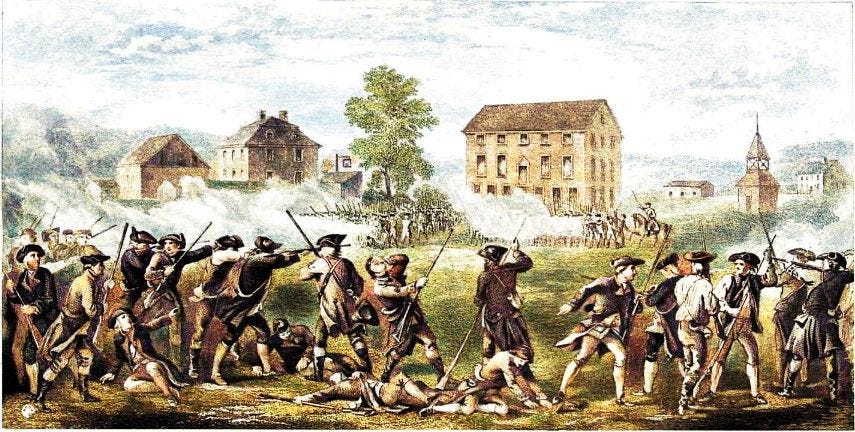
The British later claimed they didn’t fire it, and the Americans claimed they didn’t fire it. Whether purposeful or accidental, it triggered the war. Without orders, the front line of soldiers fired a volley at the provincials, followed by the second and third ranks. Eight of the rebels were killed. The army disengaged and continued its march on Concord.
The delay at Lexington allowed the colonists to assemble in force at Concord. After a disorganized battle, the British regulars retreated, harassed by the Americans. Soldiers were wounded and killed, and their ammunition was almost gone. The retreat became a rout. Once past Lexington Green, the officers were able to reestablish order, and further down the road, they were joined by reinforcements. By the time they arrived in Boston, seventy-three were dead, twenty-six were missing, and 174 were wounded.
Several who were wounded during the retreat through Lexington were left behind. They were taken to Buckman Tavern and treated by Joseph Fiske, Lexington’s town doctor. One died three days later and was interred in the Old Burying Ground. His comrades may have known his name, but the British Army didn’t record the details for common infantrymen. Which of the many names on the muster rolls belonged to him is no longer known.
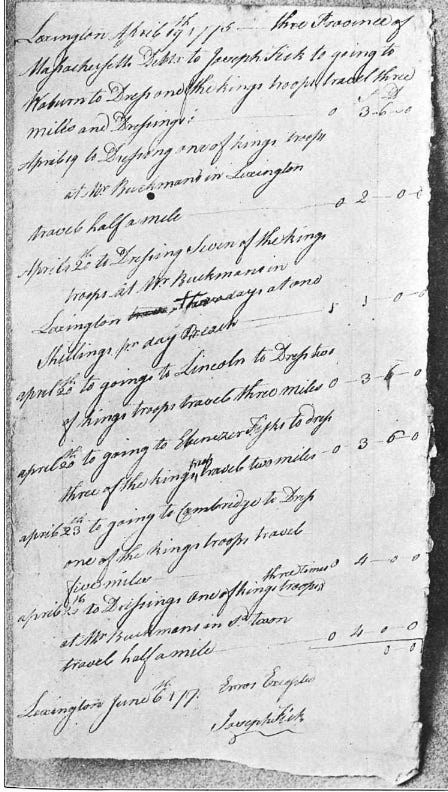
He may have volunteered or was compelled to enlist to avoid imprisonment or the gallows. The army provided food, shelter, and a small income, but for the rank and file, enlistment was a lifetime commitment. As for his family in England, they probably never heard from him again—and never expected to. No effort would have been made to notify them of his death.
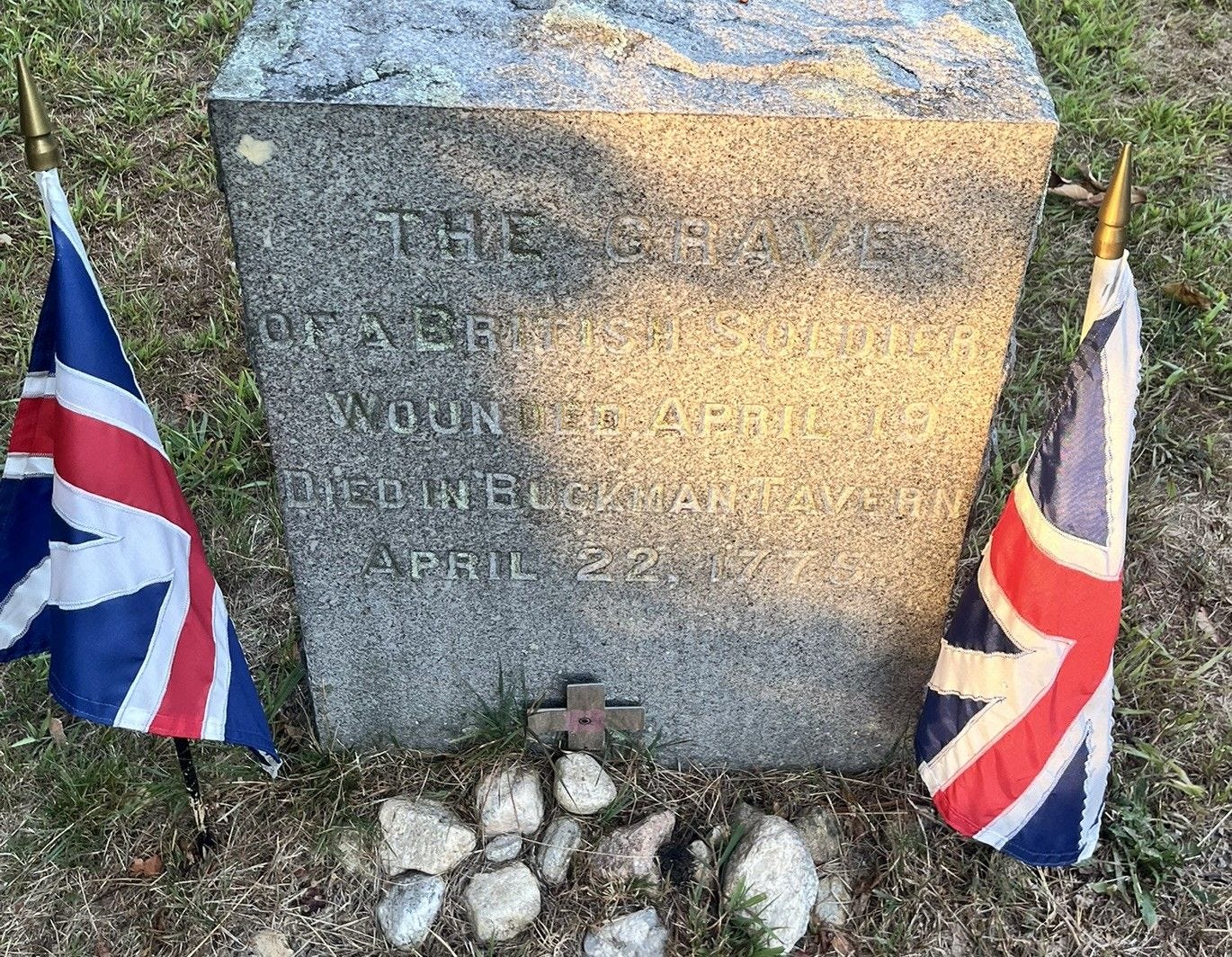
The grave was unmarked, but its location was reportedly passed down from Nathan Harrington, who lived in Lexington in 1775, to his son Abijah Harrington. Abijah later showed the spot, near the Eustis monument, to Eli M. Robbins, who in turn shared it with Dr. Francis H. Brown. In 1905, Brown petitioned for a grave marker, which was erected that year by the Lexington Historical Society.
While several of the other graves fly American flags to honor their service, the grave of the unknown British soldier is marked with the Union Jack.
Source List:
Allen Frence, “The British Expedition to Concord, Massachusetts, in 1775,” Journal of the Society for Army Historical Research, Vol. 15, No. 57 (Spring, 1936), 17–31; JSTOR.
Charles Hudson, History of the Town of Lexington, Middlesex County, Massachusetts, From Its First Settlement to 1868, Bi-Centenary Edition Revised and Continued to 1912 by the Lexington Historical Society, vol. 1 (Boston: Houghton Mifflin Co., 1913); FamilySearch.
Thomas Mallinson, Assistant Curator, Lancashire Infantry Museum, Fulwood Barracks, Preston, Lancashire, England; email to Deborah Carl, 3 April 2023.
Travis Shaw, “The British Army in the American Revolution,” updated 21 November 2024; American Battlefield Trust.
J. L. Bell, “The Soldier Who Died in Buckman Tavern,” Boston 1775.
“Grave of British Soldier in Ye Old Burying Ground,” Freedom’s Way.
Find A Grave, database with images, memorial 7395553, Unknown British Soldier of the American Revolutionary War (unk-1775), memorial created by Eric Thomsen, with gravestone images by Eric Thomsen and bigjohnack.
Privacy Policy: Substack shares your name and email address with Your Family Quest. Your Family Quest does not collect any more information and does not share your information.